Guide

Which Appliances Are Draining Your Wallet the Most?

By Ryan Mitchell December 25, 2025 5 min read
Which Appliances Are Draining Your Wallet the Most? The fridge in my garage was old. Not vintage. Not retro. Just old. It came with the house. I never thought about it. It hummed along, keeping a six‑pack of Shiner and some frozen vegetables company. I finally plugged it into my Kill‑A‑Watt meter one Saturday. The number made me spit out my coffee. 180 watts. Running 24/7. That is 1,576 kWh a year. At 20¢ per kWh, $315 a year. I was paying $315 a year to keep six beers cold. The Appliance Cost Calculator can help you find your own garage fridge shock.
📊
Appliance Cost Calculator
Estimate annual cost for each appliance — find your biggest energy hogs.
All data stays in your browser — we never see it.
I ranked them of the most energy‑hungry appliances in a typical Texas home. I have audited 600 homes. These numbers are real. Your numbers might vary. But the pattern is the same. The Electric Bill Estimator can help you see the impact of each appliance on your total bill.
💰
Electric Bill Estimator
Enter your zip code, home size, and usage — see estimated monthly and seasonal costs.
All data stays in your browser — we never see it.
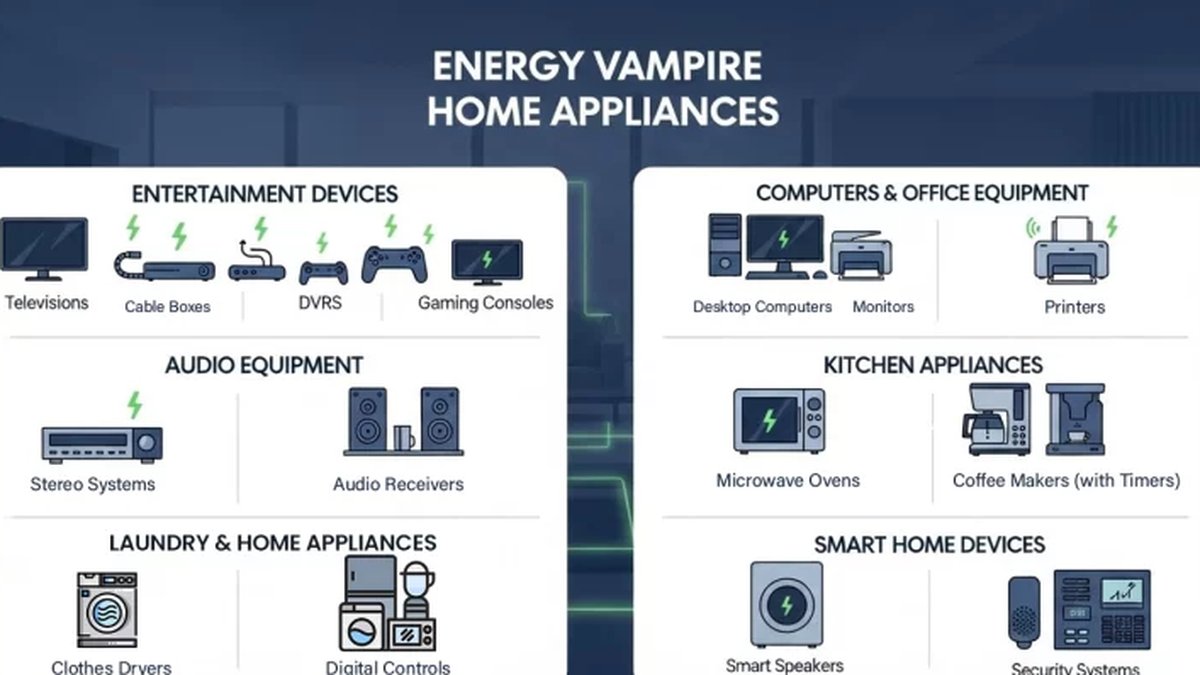
The first one is the air conditioner. In summer, it is half your bill. A 3‑ton central AC uses about 3,500 watts when running. In August, it might run 12 hours a day. That equals 42 kWh a day, 1,260 kWh a month, $252 at 20¢/kWh. The fix is not a new AC. The fix is a smart thermostat, better insulation, and regular maintenance. I changed my filter every month. I sealed my ducts. I programmed my thermostat to 78°F when I am home and 80°F when I sleep. My AC usage dropped 25%. The second one is the pool pump. This one hurts. A single‑speed 1.5 HP pump uses 1,500 watts. Running 12 hours a day is 18 kWh a day, 540 kWh a month, $108 at 20¢/kWh. A variable speed pump uses 200 watts at low speed, 1,200 watts at high. Run it low 22 hours and high 2 hours, you use 6.6 kWh a day, 198 kWh a month, $40. That comes to $68 a month saved. The pump costs $800. Payback 12 months. The Time-of-Use Rate Comparator can help you decide when to run your pool pump. The third one is the water heater. An electric tank water heater uses 4,500 watts. It runs about 3 hours a day total. 13.5 kWh a day, 405 kWh a month, $81 at 20¢/kWh. The fixes are cheap. Turn the temperature down to 120°F. Wrap the tank in an insulation blanket. Insulate the first six feet of hot water pipe. I did all three for $50. My water heater now runs 2.5 hours a day. Savings: $13.50 a month. Payback 4 months. The fourth one is the refrigerator. A modern ENERGY STAR fridge uses 75 watts. 75 times 24 equals 1.8 kWh a day, 54 kWh a month, $10.80 at 20¢/kWh. An old fridge from 2005 uses 180 watts. Same math gives 4.3 kWh a day, 129 kWh a month, $25.80. The difference is $15 a month, $180 a year. Replace that old fridge. The new one pays for itself in a few years. The fifth one is the electric dryer. 3,000 watts. 4 loads a week, 1 hour each. That works out to 12 kWh a week, 48 kWh a month, $9.60 at 20¢/kWh. The fix is a clothesline. I hang my laundry outside from April to October. Free. My shirts smell like sunshine. My fiancée approves. The Smart Thermostat Savings Estimator can help with your AC settings, which indirectly affect your dryer usage (less heat indoors means you need to run the dryer less? Not really, but you get the point). The sixth one is the electric range. 2,500 watts. 1 hour a day average. 2.5 kWh a day, 75 kWh a month, $15 at 20¢/kWh. The fix is not much. Induction cooktops are more efficient, but they cost more. I just cook dinner before 6 PM when my solar is still generating. That shifts the load. The seventh one is the dishwasher. 1,800 watts. 1 hour a day. 1.8 kWh a day, 54 kWh a month, $10.80. I run it at 9 PM on my time‑of‑use plan. Off‑peak rate is 8¢/kWh instead of 20¢. That saves $6.50 a month. The eighth one is the computer. 300 watts for my desktop. 4 hours a day. 1.2 kWh a day, 36 kWh a month, $7.20. Not much. But phantom loads add up. The ninth one is the TV and entertainment system. My TV uses 10 watts on standby, cable box 25 watts, soundbar 8 watts, game console 15 watts. 58 watts total, 24/7. That means 1.4 kWh a day, 42 kWh a month, $8.40. A smart power strip cut that to zero when the TV is off. I saved $8.40 a month. The strip cost $25. Payback 3 months. The Home Energy Score Calculator can help you prioritize which appliance to tackle first.
🏠
Home Energy Score Calculator
Answer 20 questions about your home — get a 1-10 score and prioritized upgrade list.
All data stays in your browser — we never see it.

The math for my own home after I fixed everything. I made a spreadsheet. Before fixes, my annual usage was 12,000 kWh. After fixes, it dropped to 9,000 kWh. That 3,000 kWh reduction saved me $600 a year at 20¢/kWh. The fixes cost me $1,200 total. Payback 2 years. After that, pure savings. My neighbor copied my approach. He replaced his pool pump, his old fridge, and his garage freezer. He added a smart thermostat and a smart power strip. His bill dropped from $300 a month to $180. He told me “I should have done this five years ago.” The Solar ROI Calculator is for solar, but I used it to see if adding solar after efficiency upgrades would be worth it. After reducing my usage from 12,000 kWh to 9,000 kWh, I could install a smaller solar system. 9,000 kWh requires 6 kW of solar. 12,000 kWh would require 8 kW. The smaller system cost $6,000 less. My payback period dropped from 8 years to 5 years. The monopoly wants you to buy their electricity. They do not want you to fix your appliances. They do not want you to install solar. They want you to pay. Do not let them. Go find your garage fridge. Plug it into a Kill‑A‑Watt. Do the math. You might be paying $300 a year for a six‑pack.
Ryan Mitchell

Ryan Mitchell

Independent energy auditor in Austin, Texas. 600+ home audits. Solar homeowner since 2021. I build calculators that expose exactly where your money goes. Two cats named Watt and Volt.