My electric bill was $147 a month, and I couldn't figure out why. I live alone in a 750-square-foot apartment in Austin. I turn off lights. I use LED bulbs. I even unplug my phone charger when it's not in use, because my dad taught me that trick in 2003. And still, $147. Every month. Like clockwork. It wasn't until I bought a $20 kill-a-watt meter that I discovered the truth: my apartment was haunted. Not by ghosts. By phantom loads.
I'm Ryan Mitchell. I run electricbillcheck.com from Austin, Texas, where the summers are brutal and the air conditioning bills are worse. I built this site because I was tired of paying for electricity I wasn't using. This story is about the $400 a year I was throwing away, and the $5 power strip that stopped it.
The kill-a-watt meter is a simple device. You plug it into the wall, then plug your appliance into it. It measures watts, amps, and kilowatt-hours in real time. I started with my TV, a 55-inch smart TV that I bought on sale and was very proud of. When it was on, it drew 85 watts. When it was off — completely off, screen black, remote on the table — it drew 12 watts. Twelve watts. Twenty-four hours a day. Three hundred and sixty-five days a year.
I did the math. 12 watts × 24 hours = 0.288 kWh per day. × 365 = 105 kWh per year. At Austin's rate of $0.14 per kWh, that's $14.70 a year. For one TV. That was off. Just to keep the remote sensor active, the network connection alive, and the "instant on" feature ready. I was paying $15 a year for the privilege of not waiting three seconds for my TV to turn on.
Then I checked the microwave. Off: 7 watts. The coffee maker: 5 watts. The printer I hadn't used in three months: 4 watts. The cable modem and router: 18 watts combined, even when I was asleep. The laptop charger, plugged in with no laptop attached: 3 watts. The gaming console in standby: 15 watts. The list went on. Device after device, each drawing a small trickle of power, each convinced that its convenience was worth my money.
The total was staggering. My phantom load — the electricity my devices consumed while I wasn't using them — was 94 watts. Constantly. That's 2.26 kWh per day. 824 kWh per year. $115. And that was just the stuff I could measure with the kill-a-watt. My electric water heater, which I couldn't plug into a meter, was probably adding another $50 in standby losses. My HVAC system's constant fan? Another $30. I was paying roughly $400 a year for nothing. For the convenience of not having to wait for a device to boot up. For the illusion that my apartment was "ready" for me at all times.
The 2026 energy landscape makes this worse. Smart homes are filled with always-on devices. Smart speakers, smart displays, smart thermostats, smart doorbells, smart plugs. Each one draws power constantly. Each one connects to WiFi 24/7. Each one updates itself in the background. The average American home now has 22 connected devices, and most of them never truly sleep. The convenience is real. The cost is hidden. And it's growing.
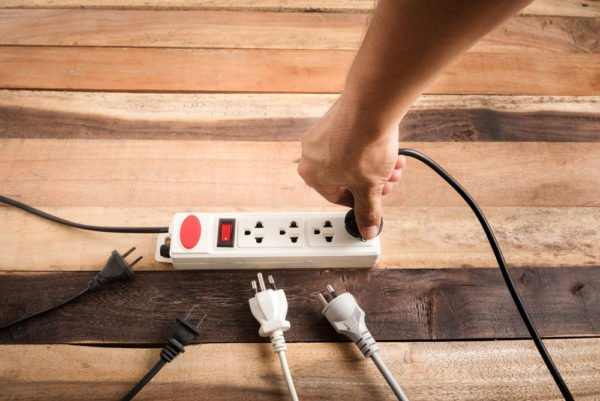
My $5 fix was a simple power strip with a switch. Not a smart power strip — those draw power too. Just a basic strip from the hardware store. I plugged my TV, gaming console, soundbar, and streaming devices into it. When I leave for work, I flip the switch. When I come home, I flip it back. Total inconvenience: about three seconds. Total savings: $45 a year, just from the entertainment center.
I added a second strip in the kitchen for the coffee maker, toaster oven, and microwave. A third in the office for the printer, monitor, and speakers. I put the cable modem and router on a timer that turns them off from 1 AM to 5 AM, when I'm asleep and not dreaming about WiFi. The total cost: $15 in power strips and a $10 timer. The annual savings: roughly $180. The strips paid for themselves in six weeks.
The psychological shift was bigger than the financial one. I had always thought of electricity as something I used when the lights were on or the AC was running. I never considered the silent drain. The idea that my apartment was consuming energy while I slept, while I was at work, while I was on vacation — it felt like a betrayal. My own home was pickpocketing me.
I built the tools on this site because I needed to see the numbers. The phantom load detector helps you identify the biggest culprits. The annual cost calculator converts watts to dollars, which is the language that actually motivates change. The smart strip savings calculator shows you how much a simple power strip can save. These tools don't require you to become an energy monk. They just show you where the money is going.
If your electric bill seems high and you don't know why, walk around your home at night. Look for the glowing LEDs. The standby lights. The devices that are "off" but still warm to the touch. Each one is a tiny faucet, dripping money into the utility company's pocket. And the fix is often as simple as a $5 power strip and the discipline to flip a switch.
How much is your home stealing from you while you sleep?